
You probably noticed it before you knew what you were noticing. The dog who once flew up the stairs now waits at the bottom for a beat. The cat who slept on top of the refrigerator has quietly been sleeping in the laundry basket instead. Mobility loss tends to creep in gradually, and most families do not realize it has started until they put together months of small observations after the fact. The earlier we start supporting a pet through these changes, the more they get to keep.
At Flora Family Vet in Kissimmee, we approach mobility care as something to plan for rather than wait through. Our AAHA-accredited practice brings the same thorough, individualized approach to mobility planning that we bring to the rest of preventive care, and our team walks every family through what their specific pet needs. Our diagnostic tools and wellness and prevention services help us catch concerns before they become limitations. Book an appointment when you start noticing changes, and we will help you figure out what comes next.
Recognizing the First Signs of Mobility Trouble
Animals hide pain. It is an old, deep instinct that has nothing to do with stoicism and everything to do with survival. The result is that most pets are well into a mobility condition before their families spot it. Knowing which signs deserve a closer look is one of the most useful tools you have.
Watch for:
- Slow, careful first steps after waking up or after a long rest, particularly when it is cool out
- A pause at obstacles they used to clear without thinking: stairs, jumping into the car, hopping onto the couch
- Loss of footing on tile, hardwood, or laminate, even briefly
- Subtle changes in how they walk: a hopping rear, a side-to-side roll, shorter strides
- Worn-flat or scraped nails that suggest the foot is dragging
- Cats who stop grooming hard-to-reach areas: mat formation along the spine, hips, or belly
- A new edge to their personality: flinching when touched, snapping when handled, withdrawing from people they used to seek out
- Restlessness or pacing when settling down
The most common driver of these changes is osteoarthritis, but the same early-stage signs can come from spinal conditions, neurological disease, or structural joint problems. The cluster of observations across days and weeks tells a more useful story than any one moment.
What does not fit a gradual pattern needs different attention. A pet who suddenly cannot use a leg, who collapses, whose hindquarters are dragging, or who has lost continence alongside weakness needs to be seen the same day. Reach out for our urgent care services when sudden changes appear.
Spinal Conditions That Commonly Require Mobility Support
IVDD and FCE
Intervertebral disc disease (IVDD) develops when one of the cushioning discs along the spine bulges or ruptures into the spinal canal, putting pressure on the cord itself. The presentation varies enormously: some dogs come in with a sore back that responds to rest and medication; others go from mild stiffness to full hindlimb paralysis within hours. Risk concentrates in long-bodied, short-legged breeds (Dachshunds, French Bulldogs, Corgis, Beagles, Basset Hounds), and most cases show up between three and seven years of age.
Fibrocartilaginous embolism (FCE) looks similar but works differently. A piece of disc material breaks loose, gets caught in a blood vessel feeding the spinal cord, and cuts off circulation to a section of nerves. The result is sudden weakness or paralysis (often more pronounced on one side or in one limb), but it does not get worse from there. The damage happens once, and recovery follows. Many dogs regain real function over a few months with rehabilitation and careful home support.
In recovery from either condition, a rear support harness keeps your dog actively using the affected limbs, which preserves muscle and supports rehab progress. For dogs left with permanent neurological deficits, a properly fitted mobility cart is the tool that gives them their world back.
Degenerative Myelopathy
Degenerative myelopathy (DM) is a progressive nerve disease that most often shows up in German Shepherds, Boxers, Pembroke Welsh Corgis, and similar breeds. It does not hurt, which can paradoxically make it harder for families to recognize how serious it is. The starting signs are gentle: a wobble that comes and goes, a paw turning under occasionally, weakness on uneven ground. Over a year or longer, the disease moves from intermittent to constant, eventually taking hindlimb function and sometimes affecting more.
The mobility plan grows with the disease. Early on, traction help around the house and a harness for stairs or longer walks usually does the job. As weakness becomes a daily presence, the harness becomes daily-use equipment. In the later stages, a cart picks up where the legs leave off, letting your dog continue doing the things that make them happy: sniffing the yard, riding along on errands, exploring on walks, watching the world go by from a place of comfort.
Amputation and Life on Three Legs
Osteosarcoma is the most common bone cancer in dogs, and it disproportionately affects large and giant breeds in the long bones of the legs. The disease is severely painful, and amputation removes the source while opening the door to additional treatments that can extend life. Cancer is not the only reason for amputation either: severe trauma, irreparable nerve damage, and certain congenital limb defects also lead to this decision.
The thing that surprises most families is how quickly dogs settle into three-legged life. Within three to six weeks of amputation surgery, most dogs are walking confidently and re-engaging with their normal routine. Front-leg amputees usually need a bit more help during the early weeks, since dogs naturally carry around 60 percent of their weight in front. A harness through the adjustment period takes pressure off the remaining limbs and prevents the compensatory strain that can otherwise cause secondary problems.
The Tripawds community is genuinely worth knowing about. The forums, recovery photos, and tips from other families who have made this decision soften the experience considerably. Hearing how other dogs adapted, seeing what week three or week six looked like for someone else, makes the choice feel less like jumping off a cliff. Our surgery services team walks through the procedure, the recovery, and the long-term picture before any decision is made.
Types of Mobility Devices Available
Support Harnesses
Support harnesses come in three main configurations, and which one is right depends on where your dog needs the help:
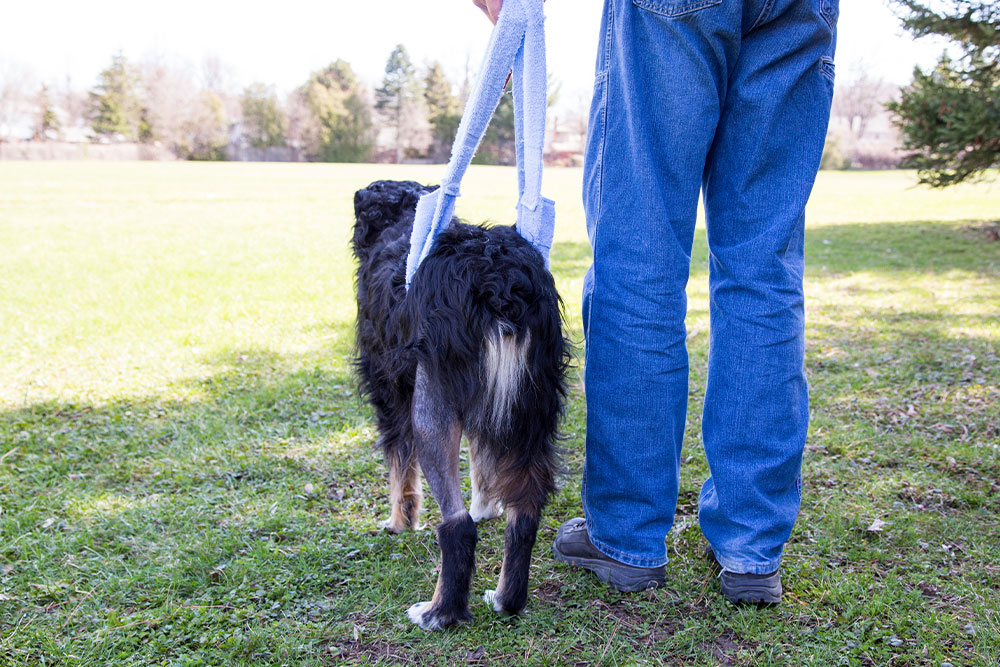
- Rear-end harnesses: The standard choice for hindlimb weakness, whether from DM, IVDD recovery, hip dysplasia, or a back-leg amputation. A rear-end harness gives you a controlled grip for sharing weight without straining either of you.
- Front-end harnesses: The right choice when the front limbs are the problem, whether from recent surgery, neurological weakness, or front-leg amputation.
- Full-body harnesses: A full-body lift harness supports both ends and is appropriate when weakness is throughout: late-stage DM, multi-joint arthritis, or recovery from significant abdominal or spinal surgery.
A harness that does not fit well is a harness your dog will fight. Look for even pressure across broad surfaces, no rubbing at the legs or chest, and no restriction in the gait. Most dogs accept a well-fitted harness within a week when you introduce it patiently: short sessions, a treat or two, no pressure.
Mobility Carts
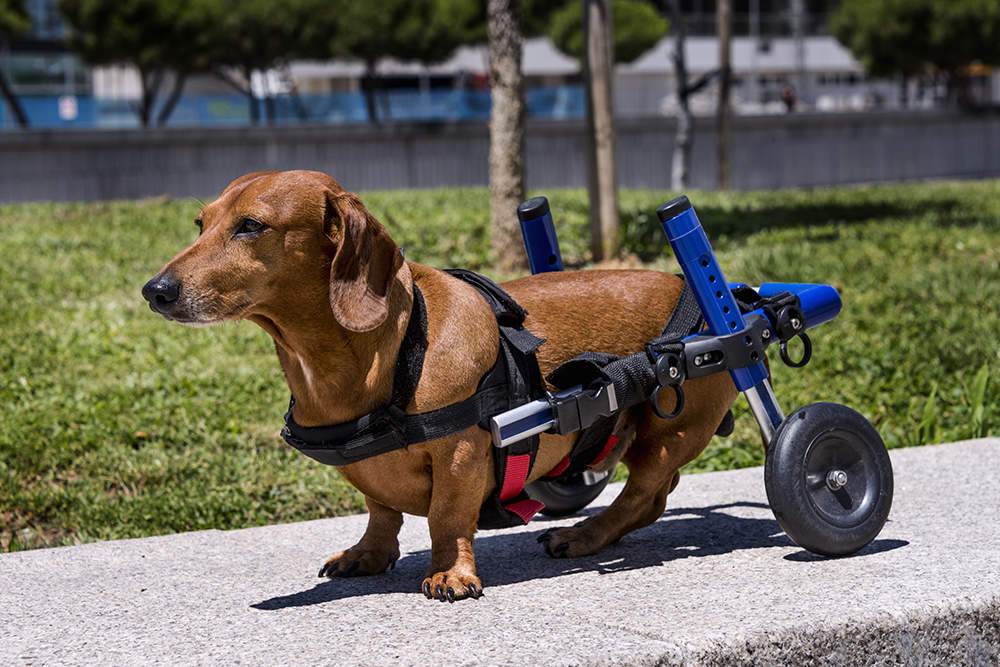
A wheeled mobility cart gives a dog something nothing else can: independent movement when their hindlimbs no longer support them. The frame holds the back end up, the wheels do the work, and the dog drives forward with whatever leg function remains. Most dogs are using a cart confidently within a week of consistent introduction.
A few practical pointers:
- Get the fit right from the start. Off-the-shelf carts work for plenty of dogs, but custom fitting is often worth the cost. A cart that does not fit causes pressure sores and refusal to use it.
- Carts are for active periods, not all-day wear. Time out of the cart matters for skin care, comfort, and continued use of any remaining limb function.
- Check the contact points during the first weeks (inner thighs, shoulders, abdomen) for redness, hair loss, or rubbing.
There is a moment most families remember: the first time their dog discovers what the cart does. The dogs who had stopped wanting to go anywhere often turn into something close to puppies again the moment the wheels are involved.
Traction Aids and Knuckling Solutions
Slick floors are one of the easiest mobility problems to solve, and they cause more falls than almost anything else for dogs with hindlimb weakness. Options to consider:
- Rubber toe grips: small rubber rings that fit over individual nails, providing real grip without anything around the paw
- Paw wax: brushed onto the pads, useful for short outings rather than all-day wear
- Non-slip socks: indoor only and they wear through quickly, but inexpensive and easy to introduce
- Traction booties: more durable, suitable for outdoor use and rougher conditions, good for active dogs who need protection alongside grip
- Area rugs and runners: the most consistent solution since the traction is built into the floor rather than what your dog is wearing
For dogs whose paws are starting to turn under (knuckling), a no-knuckling training sock attaches to the leg and pulls the foot into position. The sock protects the skin from being scraped raw and helps retrain proper foot placement while there is still nerve signal to work with.
Home Modifications That Support Pet Mobility
The home environment can support mobility care or work against it. Some of the highest-impact changes are small and inexpensive:
- Cover the slippery routes your pet uses every day with rugs, runners, or grip mats
- Replace stairs with ramps at the bed, the couch, the car, and over any step that has become difficult
- Raise the food and water bowls so your pet does not have to crouch
- Switch to orthopedic bedding placed at floor level, in low-traffic spots, away from drafts
- Block off the dangerous areas: stair gates, pool fences, balcony barriers
Home modifications for cats have additional considerations:
- Adjust the litter box by lowering one side or providing a step
- Add graduated steps or ramps to cat trees, window sills, and other vertical access points
- Beds with heating pads help soothe painful joints
Make changes one or two at a time rather than reorganizing everything in a weekend. You will see what is actually helping, and your pet will adapt more easily than to wholesale rearrangement.
How Mobility Devices Fit Into a Complete Care Plan
Devices solve mechanical problems. They do not solve pain, body weight, or muscle loss. The comprehensive mobility management approach pulls all of these pieces together, with assistive equipment supporting the work medicine and rehabilitation are doing in parallel.
Pain management is a critical part of keeping your pet comfortable:
- NSAIDs including Carprofen, Galliprant, and Meloxicam provide steady daily relief for arthritis pain. Long-term use requires periodic bloodwork to confirm liver and kidney function. Human NSAIDs (ibuprofen, naproxen) are toxic to pets and should never be used.
- Monoclonal antibody injections are a relatively new category that has reshaped what is possible for arthritis care. Librela for dogs and Solensia for cats are monthly injections that target chronic pain at the source. They have been transformative for cats specifically, since arthritis in cats is dramatically underdiagnosed and oral medication is often a non-starter.
- Gabapentin addresses the nerve-pain piece that comes with conditions like IVDD or DM. It works alongside NSAIDs rather than replacing them, hitting a different type of pain through a different pathway.
- Laser therapy reduces inflammation, improves circulation, and accelerates healing when used regularly and is a great way to add additional pain relief on top of pharmaceuticals.
Veterinary physical rehabilitation does what no device can: rebuilds muscle, restores range of motion, and slows the gradual loss of function. Hydrotherapy, manual therapy, controlled walking on different surfaces, and tools like progressive resistance bands all play a role. Devices and rehab are complementary, not alternatives.
Body weight is the other piece often left out of the conversation. Every additional pound on a small or arthritic pet adds real, measurable strain to inflamed joints with every step. Our wellness and prevention services include weight management plans and joint screening as part of standard preventive care. Ask us what medications might be right for your pet, and consider regular laser therapy sessions at Flora as a part of your pet’s mobility management regimen.
What Improvements to Expect From a Mobility Device
The wins worth tracking in mobility care are often the quiet ones. What to watch for:
- More confident movement through the parts of the house your pet had been avoiding
- Re-engagement with the family: coming to greet you, following you between rooms
- Easier transitions: less hesitation getting up after a nap, going outside, climbing into the car
- Better, deeper sleep with less restlessness or pacing
- Fewer accidents as accessing the litter box or yard becomes manageable again
- Returning to favorite spots they had stopped using when they got hard to reach
A cat who starts grooming the base of her tail again. A dog who decides on her own to climb back onto the couch. These are real wins. They mean the plan is working.
The plan needs to evolve. Conditions like DM and severe arthritis change over time, and what works at month three may need adjusting by month nine. Regular check-ins keep the support matched to your pet’s current needs rather than letting the gear become outdated as the disease progresses.
Frequently Asked Questions About Pet Mobility Aids
How do I know if my pet is in pain rather than just slowing down?
Pain in pets often shows up as a behavior change rather than a vocalization. Reluctance to climb stairs, struggling to rise from rest, hopping in the back, gait changes, withdrawing from family activity, irritability with handling, and reduced grooming all suggest pain rather than peaceful aging.
How quickly do pets adapt to harnesses and carts?
Harnesses are usually accepted within a week of patient introduction. Carts take three to seven days for confident use, and many dogs become enthusiastic about them once they understand what the cart lets them do.
Can cats benefit from mobility aids?
Absolutely. Ramps, grippy steps, heated orthopedic beds, and lower-sided litter boxes make a substantial difference for arthritic cats. Carts and harnesses are used less often in cats but are appropriate in some situations, particularly with neurological conditions.
My pet seems stiff only in the morning. Is that still worth addressing?
Yes. Morning stiffness that loosens after movement is a textbook arthritis pattern, not a quirk of aging. Pets who warm out of stiffness are still in pain during those first minutes, every single day. Treating earlier slows progression and improves long-term comfort.
Are there risks to using mobility carts long-term?
Used correctly, carts are safe. The risks worth managing are skin irritation from poor fit, muscle loss in supported limbs if the cart replaces all activity, and overexertion when a dog rediscovers movement. A properly fitted cart, balanced with rehabilitation and time out of the cart, addresses all of these.
Partnering to Support Your Pet’s Mobility
Mobility challenges do not have to mean a smaller life. With early intervention, the right combination of devices, sensible home modifications, and pain management built around your pet’s specific needs, most pets continue to live full, comfortable, engaged lives. The earlier you start the conversation, the more strength your pet retains and the more options stay open to you.
If your pet is struggling with movement (or even just not as eager to move as they used to be), contact us or request an appointment. We will build a plan that fits your pet, your home, and the way your family lives.